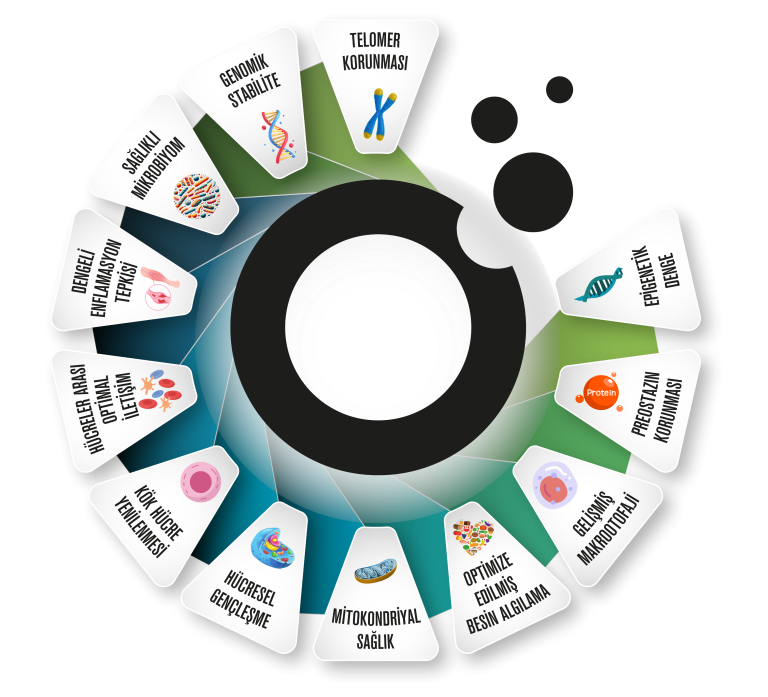
12 biological processes, one framework. Tap a tile.
Last updated:
Each tile on the wheel describes one biological process. The O in the centre tells the story of how we read this map.
The story
One map, two readings
Scientists describe ageing through changes that appear in cells over time in a shared pattern. The “Hallmarks of Aging” paper by López-Otín and colleagues, published in 2013 and updated in 2023, lays these changes out like a map.[1][2]
We looked at this map from the positive side. In place of the signs of ageing, we put the biological processes associated with a long and healthy life. We adapted the framework for ourselves and called it The Hallmarks of Longevity. The 12 headings on the wheel each explain one process with an everyday comparison.
Why a positive framework?
The map of ageing describes what changes in cells over time. We chose to read the same map through the work cells keep doing every day. The focus then moves from loss to the processes that are maintained. This is a choice of perspective. It does not put forward a new scientific finding and does not change what the map says.
Based on: López-Otín and colleagues, Cell 2013 and 2023[1][2]
The tip of a shoelace
Telomere Protection
You can think of telomeres as the plastic tip at the end of a shoelace. The tip keeps the end of the lace from fraying.
Telomeres form a similar cap at the ends of chromosomes, and they get a little shorter with each cell division. Telomere protection is one of the biological processes involved in passing on genetic information accurately when a cell divides.
Counterpart in the scientific map: telomere attrition[2]
Hardware and software
Epigenetic Balance
You can think of your DNA as a computer's hardware and the epigenetic system as the software running on it. The hardware stays the same. The software decides which program runs and when, without changing the hardware.
Epigenetic marks likewise decide which gene is active in which cell and when, without changing the DNA sequence. This balance is one of the biological processes involved in cells keeping their own identity.
Counterpart in the scientific map: epigenetic alterations[2]
A well-run library
Proteostasis Maintenance
You can think of proteostasis as a well-run library. New books go on the right shelf, worn-out books are removed and the order is checked all the time.
A cell folds its proteins correctly, clears out misfolded or worn-out proteins and keeps its protein balance in order. Proteostasis is one of the biological processes involved in keeping order inside the cell.
Counterpart in the scientific map: loss of proteostasis[2]
A regular house clean
Enhanced Macroautophagy
Macroautophagy is the process by which a cell breaks down and recycles its own worn-out or non-working parts. You can think of it as a regular house clean.
Old things are sorted out and their materials are used again. Macroautophagy is one of the biological processes involved in renewing the parts of a cell.
Counterpart in the scientific map: disabled macroautophagy, added in the 2023 update[2]
A city's traffic lights
Optimised Nutrient Sensing
You can think of the nutrient-sensing system of cells as a city's traffic lights. Nutrients send cells signals about growth, repair and energy use.
On green, cells turn to growing and multiplying. On red, they slow down, save their resources and turn to maintenance work. When the lights change in balance, the traffic flows. If the light stays green, the traffic jams.
Counterpart in the scientific map: deregulated nutrient-sensing[2]
The cell's power plant
Mitochondrial Health
Mitochondria are small structures often called the power plants of the cell. You can think of them as the generators in a factory.
They turn the energy from food into a form the cell can use (ATP). A cell whose energy needs are met can keep doing its work. How mitochondria work is one of the biological processes most often studied in research on a long and healthy life.
Counterpart in the scientific map: mitochondrial dysfunction[2]
A city that renews itself
Cellular Rejuvenation
Picture a city that renews itself over time. Old buildings that no longer serve their purpose come down and new ones go up in their place.
In the body, cells that have lost the ability to divide and no longer do their job (senescent cells) can build up over time. Clearing these cells and replacing them with new ones is one of the biological processes involved in tissues keeping their function.
Counterpart in the scientific map: cellular senescence[2]
Looking after a garden
Stem Cell Renewal
Stem cell capacity describes the ability of tissues to make new cells. You can think of it as looking after a garden. The gardener plants new seedlings in place of the plants that have dried out, and the garden stays alive.
Stem cells are the source of the new cells that replace worn-out ones. This capacity is one of the biological processes involved in keeping the structure of tissues intact.
Counterpart in the scientific map: stem cell exhaustion[2]
An orchestra
Optimal Intercellular Communication
Think of your body as an orchestra. Each musician is a cell, playing its own instrument: its signalling pathways.
Cells talk to each other through hormones, nerve signals and the molecules they release. This communication is one of the biological processes involved in different tissues working together and in keeping the body's internal balance (homeostasis).
Counterpart in the scientific map: altered intercellular communication[2]
A measured fire service
Balanced Inflammatory Response
Inflammation is the body's natural response to an injury or a foreign agent. You can think of it as a fire crew responding to a forest fire. The crew reaches the flames quickly and returns to the station once the fire is out.
A balanced response starts when it is needed and ends when the job is done. This balance is one of the biological processes involved in how the immune system works.
Counterpart in the scientific map: chronic inflammation, added in the 2023 update[2]
A busy city
Healthy Microbiome
Think of your gut as a busy city. Its residents are trillions of microorganisms, including bacteria, fungi and viruses.
Together they make up the gut microbiome. The order of a city depends on how well its residents get along. In the microbiome too, the variety of species and the balance between them is one of the topics studied in research on a long and healthy life.
Counterpart in the scientific map: dysbiosis, added in the 2023 update[2]
Security at a museum
Genomic Stability
You can think of genomic stability as security at a museum. The valuable works in the museum are the genetic information in your DNA.
The security guards are the cell's mechanisms that spot and repair damage to DNA. DNA can take small amounts of damage all the time from factors outside and inside the cell. Genomic stability is the set of biological processes involved in spotting and repairing this damage.
Counterpart in the scientific map: genomic instability[2]
Sources and note
López-Otín C, Blasco MA, Partridge L, Serrano M, Kroemer G.The Hallmarks of Aging.Cell. 2013;153(6):1194–1217. doi:10.1016/j.cell.2013.05.039
López-Otín C, Blasco MA, Partridge L, Serrano M, Kroemer G.Hallmarks of aging: An expanding universe.Cell. 2023;186(2):243–278. doi:10.1016/j.cell.2022.11.001
This page is a framework for thinking. It is not a health assessment or a product recommendation, and it makes no claim about any effect of our products on these processes.
Keep reading
Guides
Longevity Insights
All our short, free, evidence-based guides in one place.
We always use the cookies the site needs to work. We ask for your consent to measure visits (analytics) and to show you relevant ads (marketing). Details are in our Privacy and KVKK notices (in Turkish).